- Carry out all plastic, tin and other non-biodegradable material you carry in.
- Respect sacred sites and local traditions. Remove your shoes before entering temples.
- Ask for permission before taking people’s photographs. It is important to respect people’s privacy.
- Respect mealtimes and customs of your homestay family.
- GBPNIHE, Sikkim Regional Centre, Pangthang, Gangtok
- Photo Gallery
Bandapani
Home / Pilot
site / Bandapani
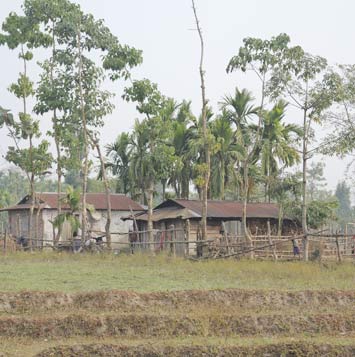
The Bandapani pilot site, located at the foothills of Khangchendzonga Landscape- India, is recognized as one of the transboundary pilot sites under KLCDI-India. It is located along Bhutan border. The site covers 16 Km2 spatial area. The Bandapani site comprises of four villages, viz. Ashram line, Garochira, Sukti and Waiba, inhabited by Nepali and Tribal including Adibasi communities, representing three ethnic groups (Hindu, Buddhist and Christian).
The Bandapani site has four rivers namely Dumchi river, Khakrariver, Kaichaley river and Sukti river. There are no drinking water sources available in the area. Drying of river in the winter seasons provides opportunity to the local people to work at the river site and sell and supply of sands and stones available at the dried out river. Bandapani receives water through Dumchiriver and other streams from Bhutan hills. There are two important markets towards eastern side, i.e. Makrapara tea garden (India) and Gomtu (Bhutan) where people from either country depend on each other for marketing and other purposes.
Eco-climate
The eco-climatic zone of terai region encompasses tropical and sub-tropical forests and grass lands, manipulated with bio-geographical range of Bhutan hills. The villages are surrounded by natural and planted forest patches.
Corridor Connectivity among Protected Areas
The Bandapani site is located between three protected areas, Jaldapara National Park and Gorumara National Park and Buxa Tiger Reserve, which marked as a corridor for the wildlife movement, especially the Elephants. The frequent wildlife entry in the village areas has been seen destroying the agricultural field and also causing threats to the lives of the people.
Unique Issues’ Centric
Discussion with the local people of the area helped surface out all the big and small issues of the
community as well as the surrounding ecosystems. There are many vital issues, such as, human wildlife
conflicts (especially Human Elephant conflicts), dolomite siltation from the Bhutan foothills, limited
socio-economic opportunities, closed tea gardens, weak tourism management and coordination,
overdependence on natural resources, unorganized grazing, scarcity of drinking water including
irrigation, loss of water sources in the Bhutan foothills because of dolomite mining, high illiteracy
rate and poor health facilities, and other transboundary problems, etc.
Issues
- >> Heavy and unmanaged extraction of the fuel wood by the village people from the surrounding forest, for household purposes as well as for marketing purposes as an optional income source
- >> Decrease in the diversity of the tree species
- >> Understory vegetation (shrubs and herbs) are almost negligible at various places as a result of monoculture plantation and deposition of Dolomite dusts
- >> Large pieces lands are still left fallow/barren and some include the patches of closed tea gardens
- >> Declining fodder availability for the cattle and also the shrinking resource of wild edible plants for the wildlife
- >> Forest fragmentation due to tea gardens, road construction, etc.
- >> Declining availability of wild medicinal species
Do's
Dont's
- Pollute streams, rivers, and other water sources with chemical detergents, soaps, or shampoos.
- Harm or remove local plants and animals. Leave the environment better than you found it.
- Leave cigarette butts or start open fires in the forest.
- Contribute to noise pollution. Avoid blasting music in reserve areas.
-
 Rhododendron Festival
Enjoy stunning views of mountainsides turned pink by hundreds of . . .
Rhododendron Festival
Enjoy stunning views of mountainsides turned pink by hundreds of . . .
-
 Cultural Festival
There is a Lingdem Hot Spring Nature and Culture Tourism Festival every year! Come to enjoy
sporting events,
Cultural Festival
There is a Lingdem Hot Spring Nature and Culture Tourism Festival every year! Come to enjoy
sporting events,
-
 Elephant migration
Discover the beauty of the majestic elephant . . .
Elephant migration
Discover the beauty of the majestic elephant . . .
-
 Trek
On some of the best routes in India and across the Himalayas
Trek
On some of the best routes in India and across the Himalayas
-
 Stay
In cozy homestays with home-cooked, organic meals
Stay
In cozy homestays with home-cooked, organic meals
-
 Explore
The incredibly diverse local flora, fauna, and culture
Explore
The incredibly diverse local flora, fauna, and culture
-
 Relax
In the fresh mountain air with beautiful panoramic views
Relax
In the fresh mountain air with beautiful panoramic views





Copyright All Right Reserved
Website is developed under KLCDI-India programme