- GBPNIHE, Sikkim Regional Centre, Pangthang, Gangtok
- Photo Gallery
The Khangchendzonga Landscape
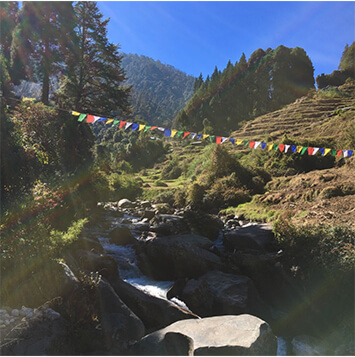
The Khangchendzonga Landscape, covering over 25,000 square kilometers in India, Bhutan, and Nepal, is a
part of a global biodiversity hotspot. It supports life for over 7.25 million people and ranges in
altitude from 40 meters above sea level in the plains of West Bengal to 8586 meters at the summit of
Mount Khangchendzonga in Sikkim. Mean temperature varies from 2°C to 19°C in Darjeeling, 7°C to 27 °C in
Gangtok and 11°C to 32°C in Jalpaiguri.
Snow, ice, and glaciers on 11 high mountain peaks feed mountain streams, lakes, and ponds across the
landscape. The varied altitudes contribute to the diversity of flora and fauna. More than 5,500 species
of plants and 1,500 species of animals are found in the Khangchendzonga landscape. Land types include
needle leaved forest, broad-leaved forest, mixed forest, shrub land, grassland and agricultural land.
All of these beautiful natural features are weaved into a strong socio-economic and cultural fabric.
With the aim of conserving this rich biodiversity, 16 protected areas are designated within the
landscape.
-
 Rhododendron Festival
Enjoy stunning views of mountainsides turned pink by hundreds of . . .
Rhododendron Festival
Enjoy stunning views of mountainsides turned pink by hundreds of . . .
-
 Cultural Festival
There is a Lingdem Hot Spring Nature and Culture Tourism Festival every year! Come to enjoy
sporting events,
Cultural Festival
There is a Lingdem Hot Spring Nature and Culture Tourism Festival every year! Come to enjoy
sporting events,
-
 Elephant migration
Discover the beauty of the majestic elephant . . .
Elephant migration
Discover the beauty of the majestic elephant . . .
-
 Trek
On some of the best routes in India and across the Himalayas
Trek
On some of the best routes in India and across the Himalayas
-
 Stay
In cozy homestays with home-cooked, organic meals
Stay
In cozy homestays with home-cooked, organic meals
-
 Explore
The incredibly diverse local flora, fauna, and culture
Explore
The incredibly diverse local flora, fauna, and culture
-
 Relax
In the fresh mountain air with beautiful panoramic views
Relax
In the fresh mountain air with beautiful panoramic views